The left half of the window is a program. The right half says the host is connected, and that it is playing Pulse Bloom as the first version, swapping immediately. I did not export a wav to find out whether the buffer was real. The buffer is what the host is reading.
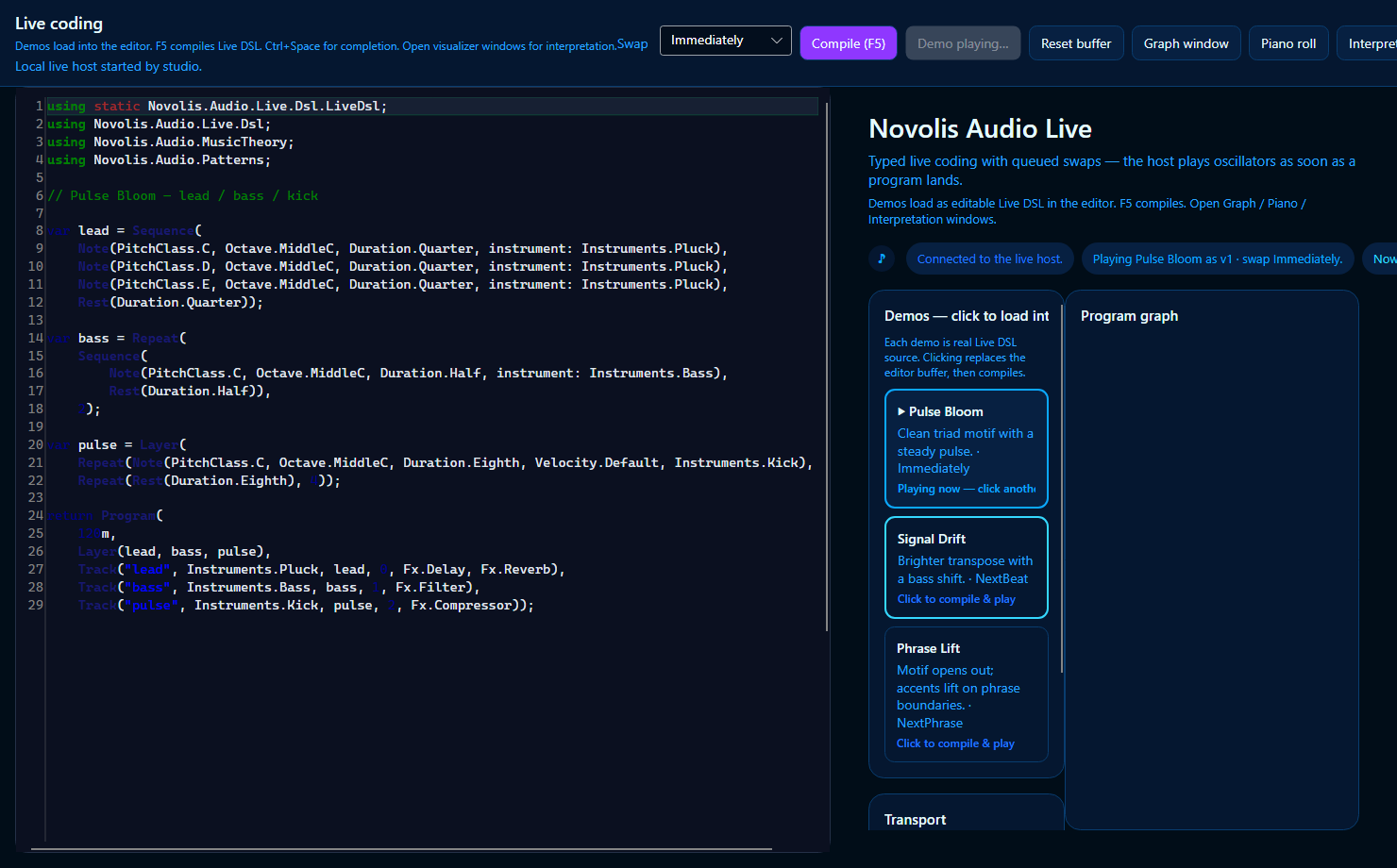
Pulse Bloom is a small piece of Live. A lead, a bass, a kick, a tempo, a couple of effects on the way out. It loads into the editor as source I can ruin. Compile is F5. The status line is the compiler's opinion of what just replaced the playing version. Replay, reset, a graph window, a piano roll. Those are views. The program is the text.
The demo is not a sample pack
The cards on the right are the same language. Pulse Bloom, Signal Drift, Phrase Lift. Clicking one replaces the buffer and compiles it. I want that, because a demo I cannot read is a demo I cannot trust. If the card says a clean triad and a steady pulse, the editor has to be the place that sentence is true. A locked preview loop would be a different product. It would also be the product that drifts the moment I want the kick an eighth earlier.
Live Studio is the window. The engine is a separate host. The studio starts it, talks to it, and can say when the pipe is down. That split is why the status line exists. "Connected" is a fact about a process, not a mood in the toolbar. When the host is late, the editor is still a file. I would rather stare at source than at a spinner that pretends the oscillators are fine.
Hear it before you draw it
The program graph sits next to the demos and it can be empty while the piece is already playing. I like that order. The sound is the program landing. The picture of the graph is a view I open when the sound is wrong. A studio that demands the diagram before the first note has confused the tool with the job.
I will keep the language small. Notes, sequences, layers, a swap policy. If I cannot hear a change by compiling the buffer I am looking at, the extra window is not a feature. It is a delay.